
Sound healing has been practiced in various forms across cultures for thousands of years — Tibetan singing bowls, Indian nada yoga, Aboriginal didgeridoo ceremonies — and has recently attracted enough scientific attention that the mechanisms are becoming clearer. It is not alternative medicine in the vague sense. There is a reasonably specific physiological account of what sound does to the body, and it is worth understanding before you walk into a session.
What Does Sound Healing Do to You?
Sound healing shifts the nervous system from sympathetic dominance (the stress state) into parasympathetic activation (the rest and recovery state) through the direct effect of sound vibration on the vagus nerve, brainwave activity, and the autonomic nervous system. The result is reduced cortisol, slower heart rate, lower blood pressure, and a state of conscious relaxation that most people find difficult to achieve through conventional rest. Slow breathing works on the same nerve, as covered in why breathing is important in yoga.
The mechanism operates through several channels simultaneously. Low-frequency sound vibration physically resonates with tissue — the body is largely water, and water transmits vibration efficiently. The auditory nervous system processes sound through pathways that directly influence the amygdala and limbic system, which govern emotional tone and stress response. And the specific frequencies produced by instruments like Tibetan singing bowls and crystal bowls appear to entrain brainwave activity toward alpha and theta states — the states associated with deep relaxation, creativity, and the threshold of sleep.
Why Is Sound Healing So Powerful?
Sound healing is particularly powerful because it bypasses the cognitive level entirely. Most stress reduction techniques work by changing what you think — reframing, cognitive restructuring, conscious breathing. Sound works at a lower level. You don’t have to do anything. You don’t have to try to relax. The vibration creates the neurological conditions for relaxation directly, which is why people who describe themselves as unable to meditate often find sound healing sessions accessible in a way that sitting practice is not. For many people it also becomes a gateway to breath practices such as pranayama.
The polyvagal dimension matters here too. Stephen Porges’s polyvagal theory describes the vagus nerve as the primary pathway of social safety and rest. Sound in the human vocal range, and particularly the frequencies produced by singing bowls, directly stimulates the vagus nerve through both the auditory nerve and through physical resonance in the chest and throat. This produces the social-nervous-system state that is associated with felt safety, connection, and deep rest. Simple postures that support this state are collected in 6 yoga poses to calm the nervous system.
Research published in the Journal of Evidence-Based Integrative Medicine found that Tibetan singing bowl meditation produced significant reductions in tension, anxiety, and depressed mood compared to silence, with participants reporting feeling significantly more spiritual wellbeing and relaxed following the sessions. The effects were consistent across age groups.
Do Healing Sounds Really Work?
Yes, sound healing produces measurable physiological effects. Research from Cambridge Sleep Sciences and multiple peer-reviewed studies confirms that sound at specific frequencies reduces cortisol, lowers heart rate variability markers associated with stress, and produces brainwave entrainment toward slower, more restful states.
What the evidence does not support is specific claims about curing disease or treating serious medical conditions through sound alone. Sound healing works in the domain of nervous system regulation and stress reduction. In that domain, the effects are real, consistent, and now reasonably well documented. Outside it, the claims need to be held more carefully.
The most honest framing is that sound healing is an effective tool for deep nervous system restoration — more accessible than meditation for many people, more immediately impactful than most relaxation techniques, and increasingly backed by research that explains the mechanism rather than just recording the outcomes.
Who Should Not Do Sound Healing?
Sound healing is contraindicated for people with epilepsy or seizure disorders triggered by auditory or vibrational stimuli, those with metal implants in the skull or inner ear (cochlear implants, plates), people in the first trimester of pregnancy where vibration near the abdomen is involved, and individuals in active psychotic episodes where altered sensory states could be destabilising.
People with severe tinnitus should approach sound healing cautiously and consult with a practitioner before attending, as certain frequencies may temporarily exacerbate symptoms. People with PTSD should also speak with a practitioner beforehand, as the deep altered states produced in sound healing sessions can occasionally surface suppressed emotional material that requires skilled facilitation rather than a standard group session.
For the vast majority of people, including those with anxiety, depression, insomnia, burnout, chronic pain, and high stress, sound healing is safe and often particularly beneficial.
How Often Should You Do Sound Healing?
For general stress management and nervous system maintenance, one sound healing session per week produces noticeable cumulative benefits. For people dealing with acute burnout, anxiety, or sleep disruption, two sessions per week for the first four to six weeks allows the nervous system to shift its baseline more quickly than weekly attendance.
The compounding effect is real. People who attend sound healing sessions in Singapore regularly describe a ratchet-like improvement where each session deepens the accessible level of rest. Early sessions often produce relaxation but not deep stillness. After several sessions, the nervous system learns the cue and enters the deep state faster and more completely. This is a training effect, similar in character to what happens with meditation but accessible faster for most people.
Monthly maintenance after an initial intensive period is what most long-term practitioners settle into.
What Instruments Are Used in Sound Healing?
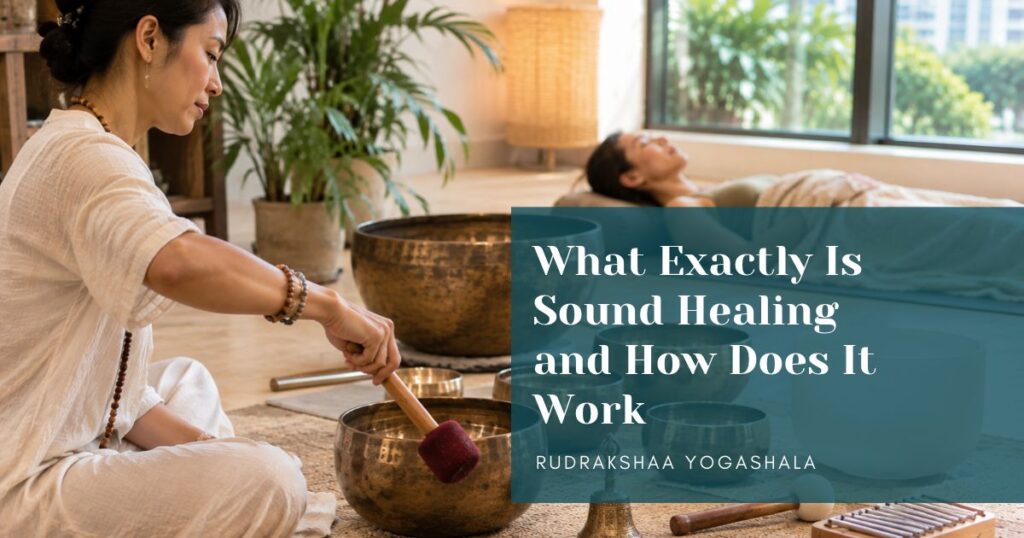
The most common instruments in sound healing sessions are Tibetan singing bowls (metal alloy bowls struck or played with a mallet), crystal singing bowls (quartz crystal bowls tuned to specific frequencies), gongs, tuning forks, and the human voice through toning or chanting. Each produces a different frequency profile and vibrational quality.
Tibetan bowls produce rich harmonic overtones in the mid-frequency range and strong physical vibration felt in the body. Crystal bowls tend to produce cleaner, purer tones and are tuned to specific frequencies corresponding to musical notes. Gongs produce the most complex frequency spectrum of any single instrument and create what practitioners describe as a “sound bath” in the fullest sense. What a full session feels like is described in the benefits of a sound bath.
Tuning forks are used in more clinical or therapeutic applications, placed directly on the body at specific points — a practice that bridges sound healing with acupressure and physiotherapy traditions.
Conclusion
Sound healing is not mysticism dressed up as therapy. The mechanisms are physiological, the research is growing, and the outcomes are consistent enough to be useful for anyone dealing with chronic stress, sleep disruption, or burnout. As a tool for nervous system regulation, it is particularly effective for people who find conventional meditation inaccessible or who want something that produces deep relaxation without requiring significant effort or skill. Gentle classes such as restorative yoga and Yin Yang sit naturally alongside it.
At Rudrakshaa Yogashala, sound healing sessions in Singapore are offered alongside traditional Hatha yoga practice. The combination — yoga for active nervous system work, sound healing for deep passive restoration — produces results that neither produces alone as efficiently. If sound healing is something you’re curious about, a session at a studio that understands both traditions is a reasonable first experience. You can check the schedule or get in touch to find a suitable session.
Frequently Asked Questions
Is sound healing the same as a sound bath?
Not exactly, though the terms are often used interchangeably. A sound bath is a specific format of sound healing where participants lie down and are immersed in sound from instruments played around them. Sound healing is the broader category, which includes one-on-one therapeutic sessions, tuning fork work, and other formats where sound is used therapeutically. All sound baths are sound healing. Not all sound healing is a sound bath.
How long does it take to feel the effects of sound healing?
Most people notice a shift in state within the first 15 to 20 minutes of a session. Deep theta states, where the most significant restoration occurs, typically emerge in the 30 to 45 minute range of a session. Effects on sleep often appear in the night following a session. Cumulative effects on baseline stress and anxiety build over weeks of regular attendance.
Can sound healing help with insomnia?
Yes, and it’s one of the more consistent clinical applications. The brainwave entrainment produced by singing bowls and gongs shifts the nervous system toward theta and delta states — the states of deep sleep and the threshold between waking and sleep. Many people who attend evening sound healing sessions report significantly improved sleep quality in the hours that follow, even if they haven’t been able to sleep deeply for weeks.
Do I need to believe in sound healing for it to work?
No. The physiological mechanisms operate regardless of belief. The vagus nerve responds to specific frequencies whether or not the person attending thinks it will work. Sceptics who attend sound healing sessions with no expectation often report the same quality of relaxation as believers. The mechanism is physical, not psychological.
Is sound healing safe to combine with yoga?
Yes, and the two practices are highly complementary. Yoga activates and regulates the nervous system through movement and breath. Sound healing deepens and consolidates that regulation through passive vibration and brainwave entrainment. Combining both in the same session or the same practice schedule produces faster and more durable nervous system change than either alone.