
How to Choose the Best Yoga Teacher Training Program in Bali
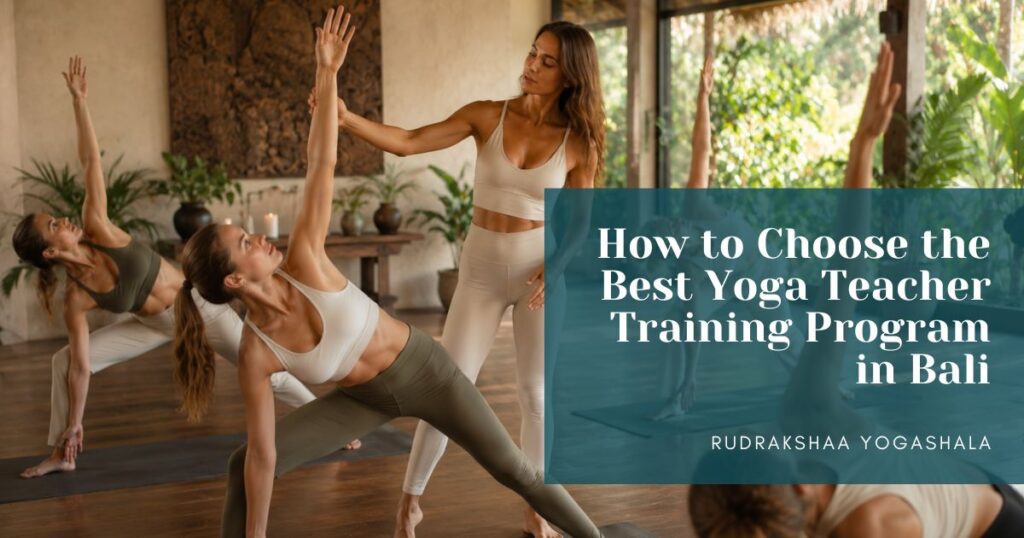
Bali keeps coming up in your searches. You’ve been practicing for a while now; something has shifted in how you think about yoga, and somewhere in the process, you started opening tabs at 11 pm, looking at programs in Ubud. That’s how it usually starts for most people who end up doing a 200-hour yoga teacher training in Bali. Not with a plan, just with a pull.
Which would be fine if the market hadn’t exploded. There are hundreds of programs running in Bali now, and everything from a decades-old lineage school to a pop-up retreat that launched six months ago looks more or less identical in the photos. The rice fields, the open-air shalas, the women in white linen. The experience behind all of that? Not the same.
Getting this wrong is expensive in ways that go beyond the tuition fee.
How Do I Choose the Right Yoga Teacher Training Program for Me?
Before anything else, get honest about why you’re doing this.
If teaching professionally is the actual goal, you need a Yoga Alliance-registered school, real anatomy content taught by someone who actually knows anatomy, supervised teaching practice with feedback that says something useful, and enough methodology that you can structure a class when you’re standing in front of people on your own. These things matter because studios hiring you will ask about them. Not nice-to-haves. Baseline requirements. Understanding the difference between traditional and modern yoga at this stage also helps you identify which lineage and approach genuinely resonates with you before committing.
If it’s personal development, you’ve got more room. Ashram-style programs in Bali run considerably cheaper, start early, and sit closer to traditional practice and philosophy. Boutique programs are more physically comfortable and considerably more expensive, and the teaching quality across that category varies more than the prices imply.
One thing worth factoring in: plenty of people arrive at these trainings treating them like a personal trip and leave wanting to teach. It’s common enough that ruling out accreditation entirely before you go seems like a gamble.
What Should You Actually Check Before Enrolling?
Accreditation first, before the photos, before the testimonials. Is the school registered with Yoga Alliance as an RYS 200? It’s not a quality guarantee on its own, but many studios in Singapore, Australia, and across Europe won’t accept a certification from an unregistered school. This is easy to verify and worth doing immediately.
Then ask for the real daily schedule. Every school will say its program covers asana practice, teaching methodology, anatomy, philosophy, and practicum. Yoga Alliance requires all five. What varies is how seriously each one is treated. Some programs list philosophy and allot a single afternoon to it. Ask for the actual hour breakdown. If there’s resistance to sharing that, you have your answer.
The lead teacher matters more than the school’s name or reputation. The lineage they trained in, how many years they’ve been teaching, what their actual background is – these shape the whole experience. A thoughtful curriculum, badly facilitated, still produces poor training. Look the teacher up independently. Former students usually say useful things if you read past the five-star reviews.
Group size comes up less often, but it matters specifically for the practicum. Cohorts of 30 or more make it very hard to get individual feedback when you’re actually teaching. Ask how many students are in each intake before you assume you’ll get real mentorship. The case for why small batch training produces better outcomes is worth reading before you assess any program’s cohort size claims.
Ubud is where most serious training in Bali takes place, and the environment earns it. Quieter, less distracted, surrounded by other practitioners. Canggu and Seminyak have programs too. Whether you can maintain a 5 am sadhana two minutes from a beach bar is a personal question worth answering honestly before you book.
How Do You Know If You're Ready?
Most programs ask for 1 to 2 years of consistent practice before enrolling. Training days run long, the material is dense, and students who are still physically managing basic postures have a harder time absorbing what’s being taught. That’s the practical reason. It’s not about gatekeeping.
You don’t need to be advanced. You need enough body awareness that when a teacher gives an alignment cue, you can find what they’re pointing to in your own body. Standing sequences, forward folds, basic backbends, and floor postures. That’s the baseline. If you’re still building that foundation, working through beginner yoga basics before committing to an intensive is a sensible step.
What rarely gets mentioned in school marketing is the emotional side of this. Sustained immersive practice far from your normal context, with reduced distractions and a lot of physical output, has a way of surfacing things. Students talk about grief, frustration, unexpected breakthroughs, and occasionally a genuine crisis of identity partway through week two. None of it is a reason not to go. It’s just worth not arriving unprepared for the possibility.
What Should the Curriculum Actually Cover?
Yoga Alliance requires five categories in any registered 200-hour yoga teacher training program: techniques and asana practice, teaching methodology, anatomy and physiology, yoga philosophy and ethics, and practicum with supervised teaching.
Those five categories are the floor, not the ceiling. The useful questions go underneath. Who is actually teaching the anatomy sessions, and do they have a background in anatomy or movement science? Does the philosophy section engage with the Yoga Sutras or the Bhagavad Gita in any real depth, or does it sit on the surface? During practicum, how many hours involve teaching actual outside students versus classmates who already know everything you’re going to say?
A strong curriculum will also dedicate real time to pranayama – not just as a warm-up technique but as a distinct and serious discipline. Understanding why breath is central to yoga practice at a physiological and philosophical level is one of the clearest markers of a program that treats the discipline seriously.
Asking the school these questions directly is worth doing. How specifically they answer – or whether they answer at all – tells you more than the program overview page.
Which Style Should You Train In?
Bali offers training across a wide range of yoga styles – Hatha, Vinyasa, Ashtanga, Yin, Restorative, and blended formats. Each shapes how you end up teaching, at least in the early years before your own approach develops.
Vinyasa suits people heading toward contemporary studio work. Ashtanga is demanding and traditional, better suited to students who want to go deep into one system rather than across several. Hatha yoga tends to be more foundational, slower, and broader in its coverage – if you’re interested in what a thoughtful, progressive Hatha approach looks like in practice, exploring Hatha Fusion is a useful reference. Yin yoga and restorative yoga work well as second certifications, but rarely hold up as a standalone first qualification in most markets.
Train in what you actually practice and enjoy. Not what seems serious, not what a friend did, not what’s appearing most in your feed this month. You’ll be inside it for a month and teaching from it for years after that. The styles that land best with students are almost always the ones the teacher genuinely understands from the inside.
Conclusion
There’s no shortage of legitimate programs, and finding a good one in Bali is genuinely possible. The filtering is the work. Check the accreditation, get the actual curriculum breakdown, find out specifically who is teaching, and read what past graduates say about the lead teacher, not just the location. If the 200-hour yoga teacher training you choose is the right one, it will push you further than you expected. If it isn’t, it’ll mostly just cost you a month.
If you’re building a consistent practice before or after your Bali yoga teacher training, Rudrakshaa Yogashala offers traditional Hatha-based yoga teacher training in Bali in a small group setting where the teaching pays genuine attention to individual students. You can learn more about us and our approach, browse upcoming classes and events, drop into a session to experience the environment first-hand, or get in touch to talk through what your next step looks like.
Frequently Asked Questions
How long does a 200-hour yoga teacher training in Bali usually take?
Yes. It is the most widely accepted professional standard-setting body in the global yoga industry. RYT designations are recognised by studios and employers across most countries where yoga is professionally taught.
Do I need Yoga Alliance certification to teach in Singapore?
A lot of studios ask for it, enough that it’s worth choosing a registered school from the start. Not every studio requires it. But the ones that don’t are becoming less common, and retrofitting your training to meet a credential requirement later is more annoying than just doing it properly the first time.
Do I need teaching experience before I enroll?
No. Teacher training is for practitioners entering teaching, not for existing teachers leveling up. A consistent personal practice matters a lot more than any prior experience at the front of a room. Ideally, a year or more of regular practice, so the first week isn’t just your body adjusting to seven hours of movement per day.
What's the real difference between intensive and part-time?
Intensive is full-time, 6 to 8 hours daily for 3 to 4 weeks straight. You are inside it completely. Part-time runs the same hours across several months. Same certification, different pace. A lot of people who’ve done the intensive format say the concentrated month changed them in ways that go beyond the schedule. Whether that’s the format or just Bali is hard to separate.