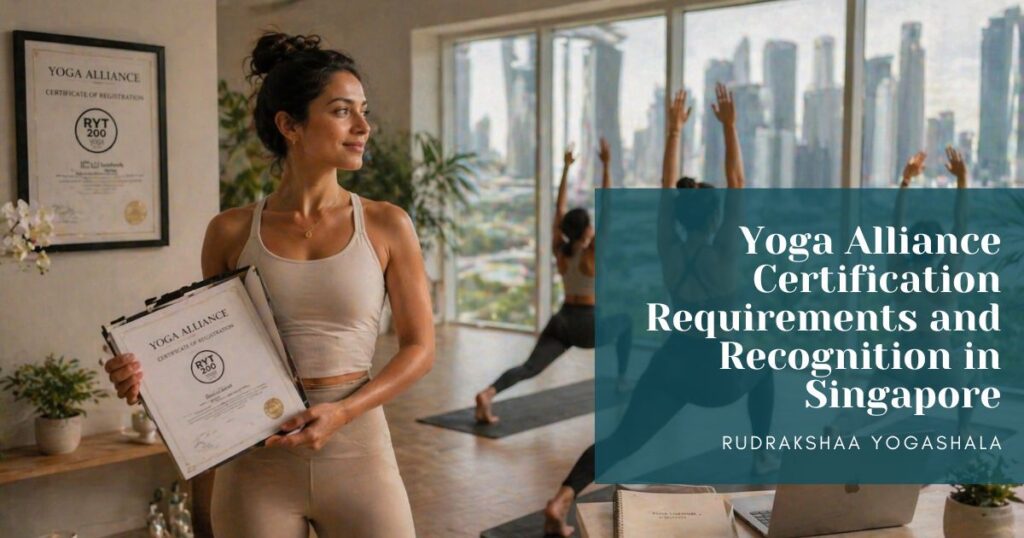

If you are looking into yoga teacher training in Singapore and trying to figure out what Yoga Alliance actually is, whether it matters, and what you need to do to get registered, you are not alone. Most people starting this process have the same cluster of questions, and a lot of the answers floating around online are either vague or outdated.
This is a practical breakdown of how Yoga Alliance certification works, what is genuinely required, and what the credential means once you have it. Particularly in the Singapore context, where the yoga industry has grown considerably, and studios increasingly know exactly what they are looking for in a prospective teacher.
What Is Yoga Alliance and Why Does It Matter?
Yes. It is probably the closest thing the yoga world has to a universal professional standard. Studios in Australia, the UK, Canada, across Europe, and throughout Southeast Asia recognise RYT designations as the baseline credential for instructors.
This portability is one of the more practical reasons to ensure your yoga teacher training in Singapore is at a Yoga Alliance-registered school, especially if you have any plans to teach abroad, relocate, or build an online teaching practice with an international audience. The credential does not need to be re-earned or re-verified when you cross a border. It travels. For a broader sense of how yoga is already transforming lives and careers across Singapore, it is worth understanding the wider context practitioners are working within.
Is a Yoga Alliance Certificate from Singapore Recognised Internationally?
Yes, with one important condition. Yoga Alliance recognition applies to the school, not the country. A certificate earned through a Yoga Alliance Registered Yoga School in Singapore carries exactly the same international standing as one earned in Bali, New York, or London. Where you trained is irrelevant to Yoga Alliance; whether the school was registered when you trained is everything.
Before enrolling in any yoga teacher training Singapore program, check the school’s RYS status directly on the Yoga Alliance website. It takes about two minutes and removes any ambiguity about whether the training will count toward your registration. Registered schools will have a current, searchable listing. Schools that are not will not.
How to Become a Yoga Instructor in Singapore
The practical pathway is straightforward, even if the training itself requires real commitment. Complete a minimum of 200 hours of training at a Yoga Alliance Registered Yoga School. The curriculum must cover five specified areas: techniques, training, and practice (asana, pranayama, meditation); teaching methodology; anatomy and physiology; yoga philosophy, lifestyle, and ethics; and practicum hours where you practice teaching under direct observation.
Understanding the role of pranayama within this curriculum is particularly important, as breath work sits at the heart of yogic teaching methodology and is one of the areas Yoga Alliance most closely scrutinises in a program’s contact hours. Similarly, if you are considering a format that fits around work or family commitments, a weekend or part-time YTT can cover the same 200-hour curriculum in a more flexible structure without compromising the credential.
Once the training is done, you register individually with Yoga Alliance online. You submit your training documentation and a certificate from your school, pay the registration fee, and upon approval, you receive your RYT 200 designation and appear in the public teacher registry.
There is no external exam and no government licensing requirement for yoga instructors in Singapore. Yoga Alliance registration is the professional standard the industry self-regulates around, and completing a good training at a registered school is the path to it.
Is Yoga Alliance Certification Legit?
This question comes up regularly, usually from people who have encountered studios or teachers dismissive of certifications in general, or who have heard of unregistered programs being sold as equivalent. The short answer is yes. Yoga Alliance is a legitimate organisation with published standards, a transparent public registry, and genuine professional recognition across the global industry.
It is not a government body. Yoga teaching is not a government-regulated profession in Singapore or most other countries. But within the professional yoga community, Yoga Alliance registration is what separates a teacher with a verifiable, standardised credential from someone who attended a weekend workshop and printed a certificate.
The more nuanced point is this: Yoga Alliance registration is a floor, not a ceiling. It tells you, your employers, and students that a minimum standard was met. What a teacher builds on top of that standard is what actually determines whether they are good. A school being Yoga Alliance registered is a necessary starting condition for a solid yoga teacher training Singapore program. It is not, by itself, sufficient. The quality of the teaching environment, including how many styles of yoga are covered and how much individual attention each student receives, matters at least as much as the registration status itself.
What Are the Minimum Requirements to Become a Yoga Alliance RYT 200?
To register as an RYT 200, you need to complete a minimum of 200 training hours at a Registered Yoga School. Of those hours, Yoga Alliance specifies that at least 180 must be contact hours, meaning direct, in-person or live training with a qualified instructor. At least 10 of the total hours must be practicum: observed teaching practice where you actually lead a class and receive feedback.
The curriculum must cover all five of the areas listed above. Programs that skip anatomy, underweight philosophy, or omit practicum hours entirely are not meeting Yoga Alliance requirements. Why breathing is treated as a foundational pillar rather than an add-on is one of the clearest indicators of whether a program takes the full curriculum seriously. If a registered school is cutting corners in these areas, that gap is worth noting when you evaluate whether their training is genuinely worth your time.
After completing the training, you register with Yoga Alliance independently. The fee structure is available on their website and is subject to change, so check current rates directly rather than relying on outdated figures.
How Long Is a Yoga Alliance Certification Good For?
The certificate you earn from your training school does not expire. But your active Yoga Alliance registration operates on a three-year renewal cycle.
To renew, you need to complete 45 continuing education units (CEUs) per cycle. At least half of those must come from non-teaching activities, such as workshops, additional training, personal study, or professional development. The remaining hours can come from teaching. Most working yoga teachers in Singapore find this manageable and genuinely useful.
The structure creates a real incentive to keep learning, which in turn tends to make people better teachers. A credential earned once and never revisited does not serve teachers, students, or the profession well. The CEU requirement exists for good reasons. Our FAQ page covers the most common questions about how this renewal process works in practice.
Which Yoga Alliance Certification Is Recognised by Studios in Singapore?
For standard teaching roles, the RYT 200 is what most Singapore studios look for and accept. It is the entry-level credential and is sufficient for the majority of teaching work you are likely to seek out in the first years of your career. You can get a feel for the kinds of classes and formats taught across different studio environments by browsing regular sessions.
The RYT 500 becomes more relevant when applying for senior teaching roles, workshop facilitation, or teacher training positions. Studios that run their own training programs will typically require their lead faculty to hold at least an RYT 500, and often an E-RYT designation on top of that.
E-RYT stands for Experienced Registered Yoga Teacher. It requires logging either 1,000 or 2,000 teaching hours after certification, depending on the level. It is not something you apply for immediately out of training. It is something you earn by teaching consistently over several years, which is exactly the point.
A Note on Choosing Your School Carefully
Yoga Alliance registration tells you a school met the minimum requirements when it applied. It does not tell you how good the teaching is, how small the batches are, how much individual attention you will receive, or whether the philosophical content is treated seriously. Those things matter at least as much as the registration status. Why small batch yoga teacher training produces better outcomes for most students meaningfully is a question worth understanding before you commit to a program.
Visit the studio before you commit. Attend a public class if one is offered. Ask about batch sizes and lead teacher backgrounds. A school that produces good yoga instructors in Singapore is usually happy to tell you about its graduates. You can learn more about who we are and how we approach teacher education on the About Us page.
At Rudrakshaa Yogashala, our yoga teacher training in Singapore programs are delivered under Yoga Alliance-registered school standards. If you want to understand how the training is structured and what graduates have gone on to do, get in touch or submit your training enquiry here. We welcome the conversation.
Frequently Asked Questions
Is the Yoga Alliance internationally recognised?
Yes. It is the most widely accepted professional standard-setting body in the global yoga industry. RYT designations are recognised by studios and employers across most countries where yoga is professionally taught.
Is a Yoga Alliance certificate from Singapore recognised internationally?
Yes, provided the training was completed at a Yoga Alliance Registered Yoga School. The international recognition applies to the school’s registration status, not the country of study.
Is Yoga Alliance certification legit?
Yes. It is a legitimate non-profit organisation with published standards and a transparent public registry. Registration is the professional baseline the global yoga industry self-regulates around, though it reflects a minimum standard rather than a measure of teaching quality on its own.
How long is a Yoga Alliance certification good for?
The certificate from your training school does not expire. Active Yoga Alliance registration renews every three years and requires completing 45 continuing education units per cycle.
How many training hours are required for RYT 200 vs RYT 500?
RYT 200 requires a minimum of 200 hours of training at a Registered Yoga School. RYT 500 requires 500 total hours: the 200-hour foundation plus a separate 300-hour advanced training, both at registered schools.
Which Yoga Alliance certification is recognised by studios in Singapore?
The RYT 200 is the standard entry-level credential most Singapore studios accept for group teaching roles. The RYT 500 is typically required for senior, workshop, or teacher-training positions.