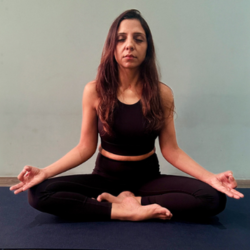
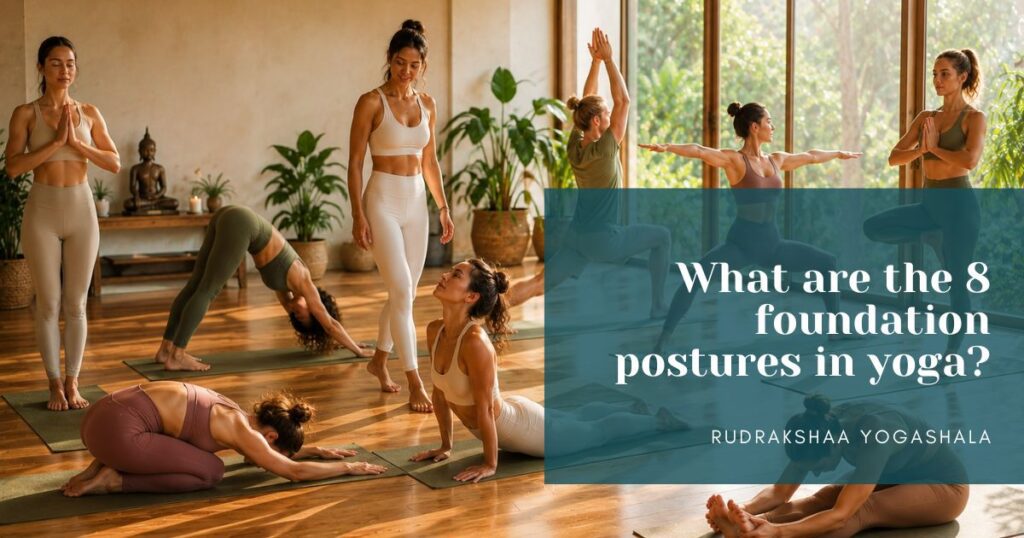

The 8 foundation postures in yoga are Mountain Pose (Tadasana), Downward-Facing Dog, Warrior I, Warrior II, Child’s Pose, Seated Forward Fold, Bridge Pose, and Corpse Pose (Savasana). These postures appear across almost every yoga style and build the core skills the entire practice depends on: standing stability, spinal mobility, strength, passive opening, and conscious rest. If you only ever worked on these eight, your practice would be in good shape.
There’s a tendency in yoga, especially early on, to judge a practice by how many poses it covers or how advanced those poses are. The classes that move through the most shapes feel the most productive. That instinct is worth questioning.
Most experienced practitioners will tell you the opposite is closer to true. What you build in the foundational postures – the ability to be still, breathe steadily, find your weight, and engage the right muscles – shows up in everything else you do on the mat. These eight poses are where that work actually happens. If you are new to the practice, working through the yoga basics before moving deeper gives these foundations the context they need to land properly.
#1) Mountain Pose (Tadasana)
Tadasana is easy to dismiss. You’re just standing. But ask anyone who’s spent serious time in it, and the story changes.
Getting Mountain Pose right means distributing weight evenly across all four corners of both feet, keeping a slight softness in the knees rather than locking them back, finding length through the spine without stiffening, and holding steady breath through all of it. Most people, when they first pay close attention, discover they’ve been leaning slightly onto one hip or gripping through the toes without realising it for years.
This is the template that every other standing pose is measured against. What you learn about your body in Tadasana – where you hold tension, how you unconsciously weight your feet, whether your breath is actually moving – you carry directly into Warrior, Triangle, and everything in between. For a broader look at how standing postures build the foundation of a practice, 5 Standing Yoga Poses for Beginners explores this progression in accessible detail.
Key action: Root through all four corners of both feet. Lift the kneecaps gently without locking the joints. Grow tall through the crown of the head.
#2) Downward-Facing Dog (Adho Mukha Svanasana)
New students are often told this is a resting pose and then spend several confused minutes wondering why it feels like the opposite. The honest answer is that it’s a resting pose once you’ve built the shoulder and hamstring capacity for it. Getting there takes time.
In Vinyasa and Ashtanga practice, Downward Dog appears more than almost any other shape. Hands shoulder-width apart, index fingers parallel or slightly turned out, hips pressing back and up, heels working toward the floor. The key thing most beginners skip is hand placement – spreading the fingers wide and pressing actively through the base of the index finger and thumb takes load off the wrists and stabilises the whole shoulder girdle.
If your wrists ache in Downward Dog, this is usually the fix. Understanding why the breath matters in this and every pose helps explain why a pose that feels effortful can genuinely become restorative over time.
#3) Warrior I (Virabhadrasana I)
The challenge in Warrior I isn’t the lunge. It’s keeping the hips squared toward the front of the mat while the back leg presses in the opposite direction. That dual action – two legs working against each other with the pelvis held neutral – is what makes it a genuinely useful posture rather than just a held squat.
For anyone working on yoga exercises for posture correction, particularly anterior pelvic tilt or a collapsed thoracic spine, this pose addresses both at the same time. The back heel pressing down lengthens the hip flexors. The arms lifting overhead open the chest and thoracic spine. Held with steady breath, it does more structural work than it looks like from the outside.
Key action: Resist the urge to open the back hip outward to get more depth in the stance. Square the pelvis as much as your body currently allows, even if it means a narrower step.
#4) Warrior II (Virabhadrasana II)
Warrior II looks powerful because it is. The wide stance, extended arms, open hips – it requires the legs to work hard while the upper body stays calm. That combination, effort below and ease above, is one of the defining tensions of yoga practice generally.
Held for multiple breaths, it builds real leg endurance and core strength. The front knee tracking over the second toe is the most common correction teachers make here – when it collapses inward, the hip external rotators have switched off. Actively pressing the knee outward re-engages them and immediately changes how stable the whole pose feels.
#5) Child’s Pose (Balasana)
Child’s Pose does something specific that most poses don’t: it presses the forehead into the floor. That contact point activates the vagus nerve, which is part of why the pose produces a disproportionate sense of calm relative to how passive it looks. It’s not just rest. Something is actually happening neurologically.
Beyond that, kneeling with hips toward heels and arms stretched long in front creates traction through the thoracic spine and a gentle opening across the upper back. For neck and shoulder pain relief in yoga, this is one of the most direct options available – particularly if you walk the hands slightly forward and let the shoulder blades completely release away from the ears. It also appears as one of the 6 yoga poses most effective for calming the nervous system, which explains why teachers return to it so consistently.
Breathe into the back body. Let the ribs expand sideways on the inhale.
#6) Seated Forward Fold (Paschimottanasana)
This pose gets misused more consistently than almost any other foundational posture. People sit down, extend their legs, and then round aggressively through the lower back, trying to reach their feet. That is not a forward fold. It’s a lumbar compression with extra steps.
The actual action is a hip hinge. The pelvis tips forward, the spine stays long, and the fold comes from the hip crease rather than from the back collapsing. A strap around the feet makes this much more accessible – it lets you maintain the right action at whatever range of motion you currently have, rather than forcing a shape your hamstrings aren’t ready for. This principle – working within your range rather than forcing a shape – is central to how traditional Hatha yoga sequences approach forward bends.
Key action: Inhale to grow tall through the spine, exhale to hinge from the hips. Repeat that micro-movement with each breath. Don’t pull yourself deeper in one big effort.
#7) Bridge Pose (Setu Bandha Sarvangasana)
If you sit at a desk most of the day, Bridge Pose is doing something directly relevant to your body. Prolonged sitting shortens the hip flexors, weakens the glutes, and rounds the thoracic spine. Bridge addresses all three in a single movement – the hips pressing upward lengthens the hip flexors, the glutes and hamstrings activate to hold the position, and the chest opens as the thoracic spine extends.
Practised a few times a week with some attention to breath, the effect on lower back comfort and standing posture is noticeable within a few weeks. For desk workers dealing with chronic back tension, this is one of the most relevant poses in the foundational set – the broader picture of yoga for back pain and posture correction explains how postures like this fit into a fuller corrective approach.
One thing worth watching: Squeezing the glutes hard at the top of the pose compresses the lower back rather than decompressing it. Think about lengthening the tailbone toward the knees instead. The hips stay high, the lower back stays long.
#8) Corpse Pose (Savasana)
Savasana is the pose people most often skip, and it’s arguably the most important one in the sequence.
Lying still with eyes closed, arms slightly away from the body and palms facing up, the aim is conscious rest – not sleep, not drifting, but settled awareness with zero physical effort. What happens during those minutes is neurologically significant. Research on motor learning shows that rest periods after physical skill practice accelerate how the body consolidates what it has just learned. You are not wasting time lying there. The work is being processed.
This is also where the restorative dimension of yoga begins to make sense – the body absorbs and integrates what it has just done. Savasana is the gateway to understanding why stillness is a practice, not the absence of it.
Stay for at least 5 minutes. If you routinely leave before Savasana, you are regularly skipping the part of class where the practice actually lands.
Conclusion
Coming back to these eight postures regularly, with attention rather than ambition, produces improvements in every other part of a yoga practice. The foundations are not where beginners work until they’re ready for something more advanced. They’re where experienced practitioners return to find what they missed the first time. Understanding how many styles of yoga there are and how differently they approach these same foundations is part of what makes the practice endlessly worth returning to. And if you’re curious about whether yoga tones the body through this kind of foundational work – the answer, built on poses like these, is yes.
Rudrakshaa Yogashala runs a dedicated Posture Correction and Pain Relief Workshop in Singapore that works directly with these foundations in a therapeutic context. If pain or postural imbalance is part of why you’re exploring yoga, that’s a more targeted starting point than a general drop-in class. You can also view the full schedule, explore our sessions, or get in touch to find the right entry point for where you are right now.
Frequently Asked Questions
Can I do foundational yoga postures if I have back pain?
Yes, most foundational yoga postures are safe with back pain when modified correctly. Bridge Pose and Child’s Pose are particularly beneficial for lower back issues. Forward folds and backbends need more individual adjustment depending on where the pain sits and what’s causing it. Always tell your teacher before class, not after. They can’t adjust what they don’t know about, and the difference between a helpful modification and an aggravating one is usually just one cue. Self-prescribing a sequence based on what feels okay at home is a different thing from doing it under a teacher who can actually see what your spine is doing.
How long should I hold each foundational pose?
In a regular yoga class, hold each foundational pose for 3 to 5 breaths. For therapeutic purposes such as posture correction or pain relief, holding key postures like Bridge or Child’s Pose for 60 to 90 seconds produces more sustained results than brief holds in a flow sequence. That said, 3 to 5 breaths is a pace answer, not a therapeutic one. The duration changes what the body is actually doing in the pose. A Bridge Pose held for a full minute with steady breath is doing structural work. The same pose held for 4 counts in a flow is mostly just a transition.
Are these poses suitable for older beginners?
Yes, all 8 foundational yoga postures are suitable for older beginners. Every one of them has chair-assisted or supported modifications that preserve the intent of the pose without the physical load. Age is not a barrier to starting with these foundations – limited mobility and joint sensitivity are common concerns, but both are manageable with the right adjustments. Mountain Pose done against a wall, Bridge with a block under the sacrum, Child’s Pose with a bolster under the torso – the foundations hold up across a wide range of starting points. More so than most people assume before they try.
How do foundational postures help with neck and shoulder pain?
Foundational postures like Bridge, Downward Dog, and Child’s Pose relieve neck and shoulder pain by creating mobility and decompression through the thoracic spine – the actual source of most upper body tension. When the mid and upper back move more freely, the neck and shoulders stop compensating for it, and the chronic tension that builds up there begins to ease. Most neck and shoulder tension is not actually a neck or shoulder problem. It originates in the thoracic spine, which stiffens from prolonged sitting and rounds forward, pulling the shoulders with it. Treating the symptom at the neck rarely resolves it. Working the thoracic spine through these foundational postures consistently is where the lasting relief comes from.