
Standing yoga poses provide the fundamental strength, balance, and body awareness needed for a sustainable practice. As the essential starting point for beginners, mastering these poses creates the stability necessary to explore more complex movements with confidence.
From the Mountain Pose to the Warrior series, the five introductory yoga positions are the perfect way to begin your journey toward a stronger body and a calmer mind. However, these benefits are only accessible when each pose is approached with mindful alignment. Your posture determines whether you are building strength safely or creating strain in your joints and muscles.
What are the Five Standing Yoga Poses?
1. Mountain Pose (Tadasana)
Mountain Pose is the foundational standing pose, helping you find a sense of stillness and inner strength, calming the mind by centring your energy and grounding you in the present moment.
Why it Matters:
Mountain Pose teaches you the art of correct posture and grounded alignment, training you to stand in a way that supports the natural curves of your spine. It reveals your postural habits, like leaning forward or slumping, and teaches you to correct them by grounding your feet and engaging your core.
Neglecting to master this foundational pose can lead to poor posture in all other poses and daily life.
How to Execute the Mountain Pose:
- Stand on your mat, aligning your feet comfortably beneath your hips, and feel your soles press gently but firmly into the ground.
- Gently engage your thigh muscles by drawing up your kneecaps to bring energy into your upper legs.
- Lengthen your spine by reaching the crown of your head upward.
- Release any tension from your shoulders and broaden your chest and collarbone.
- Allow your arms to hang naturally alongside your body, turning your palms to face the front.
- Maintain a steady breath as you hold the posture for 30 to 60 seconds and focus on the sensation of your feet pressing firmly into the ground.
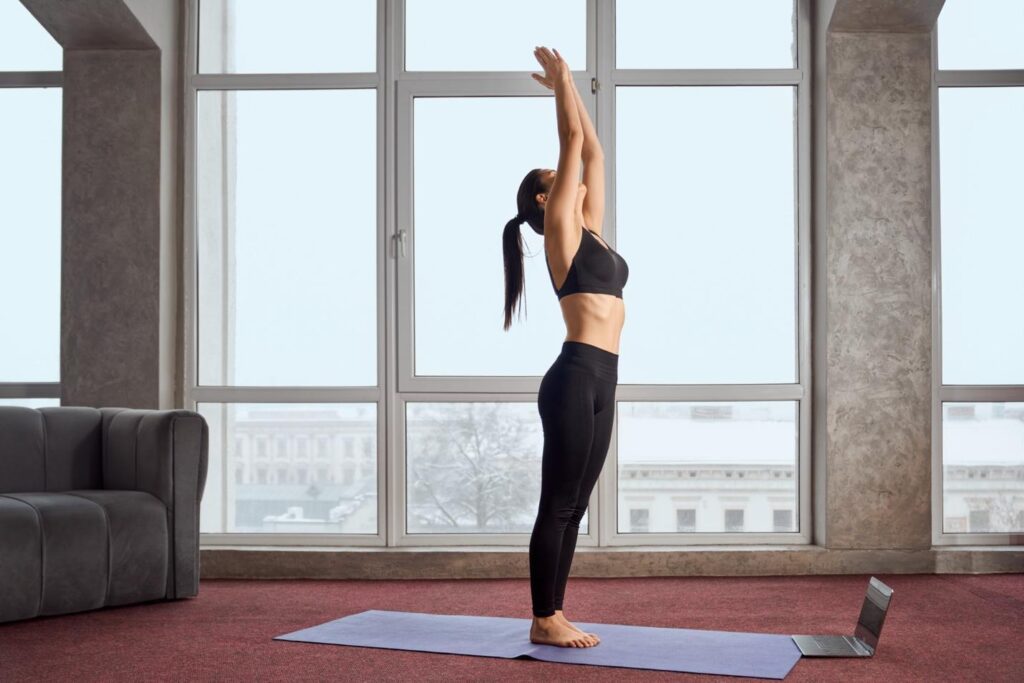
2. Raised Hands Pose (Urdhva Hastasana)
This yoga position is an uplifting, full-body stretch that naturally extends from Mountain Pose. It energizes the entire body by opening the chest and shoulders while strengthening the back and core muscles.
Why it Matters:
The raised hands pose teaches you to lift upwards without creating tension. If you allow your shoulders to hunch up toward your ears, you introduce unnecessary tension into the neck and upper back.
Finding proper form involves relaxing the shoulders while actively reaching through the fingertips, teaching you the difference between mindful effort and unnecessary tension.
How to Execute the Raised Hands Pose:
- Start with the Mountain Pose.
- Inhale as you lift your arms overhead with your palms either facing or touching each other.
- Stretch your arms and body upwards, and feel the energy extending through the crown of your head.
- Engage your core to support your lower back as you lift from the ground up.
- Gaze forward or gently up toward your hands, feeling the stretch from your heels to your fingertips.
3. Triangle Pose (Utthita Trikonasana)
The Triangle Pose is one of the classic yoga standing poses that builds power in the legs and core. It provides a deep, releasing stretch along the side of the body, including the hamstrings and spine, helping to increase flexibility and relieve tension.
Why it Matters:
This yoga position teaches you to lengthen your spine rather than just bending over. Many beginners collapse their chest to touch the floor, which strains the lower back and compresses the torso.
Instead, focus on creating length through your side by extending from the hip. The true benefit comes from this extension, not from how far down your hand can reach.
How to Execute the Triangle Pose:
- Step your feet out wide, positioning them slightly broader than your shoulders.
- Place your right foot facing 90 degrees to the short edge of your mat, and your left foot at a 45-degree angle.
- As you inhale, stretch your arms out to either side so they are level with the ground, with your palms turned down to face the floor.
- Exhale as you bend your hip joint sideways, toward your right leg.
- Bring your right hand down to your shin, ankle, or a yoga block.
- Extend your left arm toward the sky, lengthening both sides of your torso.
- Keep both legs steady and engaged.
- Repeat the same steps with your left side.
4. Warrior I (Virabhadrasana I)
Warrior I builds stability throughout the entire lower body, from ankles to thighs. This yoga position opens the hips and chest while cultivating mental stamina and focused concentration.
Why it Matters:
Warrior I highlights the importance of hip alignment. The challenge is to keep both hips facing forward, which ensures an even stretch and protects the sacroiliac (SI) joint.
How to Execute the Warrior I Pose:
- From the Mountain Pose, extend your left foot back with your toes pointing at a 45-degree angle.
- Lower into your right leg until your knee creates a 90-degree angle above your ankle.
- Make sure you are stable and grounded; otherwise, adjust your stance.
- Square your hips to face the front of your mat.
- Inhale as you raise your arms above your head. Focus on lifting your chest upward while keeping your shoulders relaxed and down.
- Reset to your starting position before repeating the movements on the left.
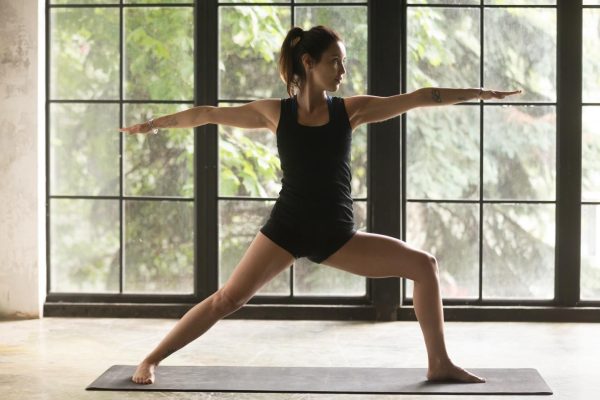
5. Warrior II (Virabhadrasana II)
If you’re looking for a standing yoga pose to improve your balance, Warrior II is a good choice. It builds grounded power in the legs and arms, increases hip flexibility, and develops a sense of inner strength and stability.
Why it Matters:
In Warrior II, the practice is centered on grounding. If the back foot isn’t firmly planted, or the front knee collapses inward, the pose loses its stability, and the knee joint is compromised.
Practicing the proper Warrior II form enables you to build your strength safely and effectively.
How to Execute the Warrior II Pose:
- From Warrior I, open your hips and torso to the side.
- Stretch your arms out to either side, holding them level with the ground.
- Keep your front knee bent in a direct line above your ankle.
- Your back leg remains straight, with the outer edge of the foot grounded.
- Turn your head and set a steady gaze (drishti) over your front fingertips.
- Release the pose, and then mirror the entire sequence from Warrior I on your left side.
Why Do Standing Yoga Poses?
Standing yoga poses are a mindful practice of building physical strength and mental awareness from the ground up. These yoga positions promote mindful living and provide several benefits, including:
Physical Benefits
- Builds Strength: These poses actively engage and fortify the large muscles of your legs, core, hips, and back, providing a stable foundation of power.
- Improves Balance: By working with gravity, standing poses train your body to be more stable, which helps improve coordination in daily life.
- Corrects Posture: The focus on alignment strengthens back muscles, helping to correct imbalances and encourage a healthier posture. For those dealing with chronic postural issues from desk work or prolonged sitting, our yoga workshop for posture correction Singapore offers a dedicated therapeutic session to address pain, realign the spine, and restore healthy posture.
- Increases Flexibility: They create gentle, sustained stretches in the hamstrings, hips, and shoulders, improving your range of motion.
- Boosts Energy: Engaging the body’s largest muscles improves circulation, leading to increased energy and a sense of vitality.
Emotional and Mental Benefits
- Cultivates Mindfulness: Holding a standing yoga pose requires you to connect with your body and breath, cultivating deep awareness and mental clarity.
- Fosters Mental Stability: The combination of physical effort and focused attention helps to calm the mind and create a sense of settled alertness.
- Develops Confidence: With consistent practice, the increasing strength and stability you gain will build confidence in your body’s capabilities.
Good Foundation for Yoga Practice
- Establishes a Strong Core Understanding: Standing yoga poses for beginners provide a crucial grounding for more advanced postures by teaching you the principles of good alignment.
- Enhances Body Awareness: These poses build a deep, natural awareness of your body’s movements, a skill that is vital for practising yoga safely and effectively
Importance of Proper Alignment in Standing Yoga Poses
In all standing yoga poses, how you hold your body truly matters. Proper alignment is the key that unlocks a practice safe and effective, helping you build a strong foundation rather than risking injury. When your joints are aligned and your muscles are engaged correctly, your body feels supported and stable. This allows you to move with a sense of freedom and ease, both on and off the mat.
Without mindful alignment, the body compensates in ways that can cause problems over time.
- Joint Strain: Letting your knee bend past your ankle in a lunge is a common mistake that puts excessive pressure on the joint. Instead of engaging your strong thigh muscles, this misalignment can lead to chronic knee pain over time.
- Muscle Imbalance: If you favor one side in a pose like the Triangle Pose, you are reinforcing uneven muscle patterns rather than correcting them.
- Blocked Breathing and Energy Flow: Poor posture in any pose can compress your torso and restrict breathing. This limits oxygen flow and can leave you feeling tired rather than energized.
Build with the Basics at Rudrakshaa Yogashala
The five standing yoga poses are an ideal introduction to a safe and sustainable practice. Learning them correctly from the start is crucial, as it builds the foundation for a lifetime of good posture and mindful movement.
Rudrakshaa Yogashala’s basic yoga classes for beginners are designed to guide you through these fundamentals with expert, hands-on instruction. In our small-group setting, you receive the individualized attention necessary to ensure safe alignment and build a confident practice.
Sign up for your first class at our studio for yoga classes in Singapore and discover a welcoming space for beginners.
Frequently Asked Questions
What are the 5 standing asanas?
While there are many, the foundational five are Mountain Pose (Tadasana), Warrior I (Virabhadrasana I), Warrior II (Virabhadrasana II), Triangle Pose (Trikonasana), and Tree Pose (Vrikshasana). These form the “skeleton” of most Hatha and Vinyasa sequences.
What is the most important standing yoga pose?
Mountain Pose (Tadasana) is the most critical because it is the blueprint for all other standing poses. It teaches you how to ground through your feet, engage your core, and align your spine—principles that apply to every asana in your practice.
What yoga poses help scoliosis?
Side-stretching poses like Triangle (Trikonasana) and Side Angle (Utthita Parsvakonasana) are excellent for lengthening the compressed side of the spine. Poses like Bird-Dog or Plank also help by strengthening the deep spinal stabilizers to support a more neutral alignment.
Can I do standing yoga every day?
Yes, standing yoga is safe for daily practice as it focuses on functional strength and balance. To avoid fatigue, alternate between high-intensity poses like Warriors and more grounding, static poses like Mountain Pose or standing forward folds.
Which yoga is best for endometriosis?
Gentle Hatha or Restorative yoga is best, focusing on poses that open the hips and pelvic floor without putting excessive pressure on the abdomen. Reclined Bound Angle (Supta Baddha Konasana) and gentle standing wide-legged folds can help relieve pelvic tension and improve circulation.
Which standing asana is good for beginners?
Mountain Pose and Tree Pose are the best starting points. They introduce the concepts of grounding and balance without requiring extreme flexibility, making them accessible for anyone regardless of their fitness level.
What are common mistakes in standing yoga?
The most frequent errors are “locking” the knees (hyperextension), holding the breath, and collapsing the arches of the feet. These mistakes put unnecessary stress on the joints and prevent the muscles from engaging correctly to support the pose.
What standing yoga pose relieves stress?
Standing Forward Fold (Uttanasana) is highly effective for stress relief because it allows the head to be below the heart, which calms the nervous system. It also releases tension in the neck and hamstrings, areas where many people “store” physical stress.
Why are standing poses important in yoga?
Standing poses build the “root” of your practice; they develop leg strength, hip mobility, and core stability. Without the foundation provided by standing asanas, more advanced seated or balancing poses are much harder to execute safely.
What are common mistakes in Warrior II?
Common mistakes include letting the front knee cave inward and leaning the torso too far forward over the front leg. Your front knee should track toward your pinky toe, and your shoulders should remain stacked directly over your hips.
Why is Triangle pose difficult for beginners?
It requires a unique combination of hamstring flexibility, hip opening, and core strength to keep the torso from collapsing forward. Beginners often struggle because they try to touch the floor rather than focusing on keeping their chest open and spine long.
How do I know if my posture is correct?
A simple test is the “wall check”: stand with your heels, glutes, shoulders, and head touching a wall. If you feel excessive strain or can’t keep these points in contact naturally, it indicates postural imbalances that Hatha yoga can help correct.
How do you maintain balance in yoga poses?
The secret is “Drishti” (focused gaze) and “Pada Bandha” (foot lock). By fixing your eyes on a single unmoving point and spreading your toes wide to grip the mat, you create a stable physical and mental base.
How long should you hold standing yoga poses?
For beginners, 5 to 10 deep breaths (roughly 30–60 seconds) is the sweet spot. This is long enough to build isometric strength and find proper alignment without causing the form to break down due to muscle fatigue.