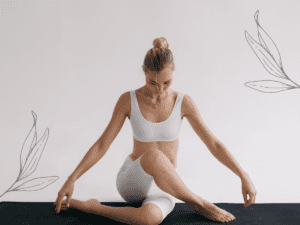

Most beginners spend their first year of yoga completely focused on the shapes. Getting the alignment right, reaching further in a forward fold, holding Warrior II for one more breath without the front knee caving. It makes sense. The poses are visible. Progress in them is measurable.
What takes longer to understand is that the poses are not the practice itself. The breath is. And once that clicks, every class you’ve ever taken starts to make more sense in retrospect. If you’ve ever wondered why breathing is so important in yoga, this is where the answer really begins.
Why Is the Breath So Important in Yoga?
Of all the things your body does automatically, breath is the only one you can consciously override. Heart rate, digestion, hormonal cycles – those run without you. Breathing mostly does, too, until you decide to change it.
That one exception matters enormously. Slow your exhale down, and the parasympathetic nervous system activates. The body shifts out of alert mode. Muscles that were holding unnecessarily start to let go. This is not a minor effect – it changes what the body is physically capable of in a posture, in real time. Most students who feel tense and resistant during class are holding their breath or breathing shallowly without realising it. The stiffness they blame on their hamstrings is often the nervous system, not the muscle. For a direct look at how yoga addresses the nervous system specifically, the stress relief and nervous balance workshop explores this in a structured, focused format.
In traditional yoga, the breath is called prana, understood as a life force rather than just oxygen exchange. Pranayama, the practice of consciously controlling it, predates the physical postures by centuries. The Hatha Yoga Pradipika, one of the foundational texts of Hatha yoga, is clear on this: asana was developed to prepare the body for pranayama. The postures came second.
What Does Breath Actually Mean in Yoga?
It covers more ground than most people expect when they first encounter it. Ujjayi breath, also called ocean breath, involves a slight constriction at the back of the throat that creates a subtle, audible sound on both the inhale and the exhale. This is the breath you’ll hear in Vinyasa and Ashtanga classes. It keeps the mind anchored internally rather than wandering, generates a small amount of internal heat, and gives the practice a consistent rhythm to move within.
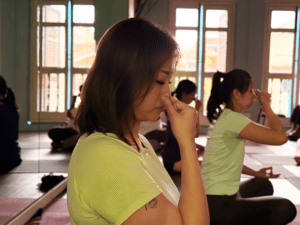
Pranayama, as a formal practice, includes techniques such as Nadi Shodhana (alternate nostril breathing), Kapalabhati and Bhastrika (rapid, forceful exhalations with distinct physiological effects), and Bhramari (a humming breath with a strong effect on the nervous system). Each one does something different. They are not interchangeable, and some are not appropriate for everyone. A grounding introduction to the four foundational breathing techniques is a useful starting point before exploring the full range.
Then there is breath-to-movement synchronisation – the pairing of specific actions with inhales or exhales. Rises and expansions go with inhalation. Folds and descents go with exhalation. This is not an arbitrary preference. The inhale physically lifts and expands the chest. The exhale softens the abdomen, which is exactly what creates space to fold forward. When the breath and movement are timed correctly, the body opens more easily than any amount of pushing could produce. When they are disconnected, what you have is exercise with a yoga mat.
Can Breathing Exercises Lower BP?
The evidence here is fairly solid. Research published in Frontiers in Physiology found that slow breathing at around 6 breaths per minute activates the baroreflex system. This pressure-regulating mechanism reduces peripheral vascular resistance, lowering blood pressure. This is not a temporary effect – the studies tracked sustained practice over weeks.
A review in the Journal of Human Hypertension examined slow breathing practised for 15 minutes daily and found clinically significant reductions in both systolic and diastolic blood pressure in hypertensive patients. The key variables were slow rate and extended exhalation, both of which are foundational to how yoga approaches breath.
Understanding the four stages of pranayama and how breath retention and extension are progressively developed gives important context for why these physiological effects compound over time rather than appearing immediately.
For anyone attending yoga classes in Singapore who has been told to manage stress-related blood pressure, consistent pranayama practice is worth discussing with your healthcare provider. It functions as a complement to medical treatment, not a replacement, and the physiological mechanism is real and reasonably well documented.
What Are the Five Golden Rules for Yoga Breathing?
Not official doctrine from any single lineage, but these five principles show up consistently across Hatha, Vinyasa, and Ashtanga traditions because they work.
Breathe through your nose
Nasal breathing filters and warms the air, naturally slows the breath rate, and keeps the nervous system calmer than mouth breathing during effort. Students who switch from mouth to nasal breathing mid-practice often describe it as the single change that transformed the class.
Let the exhale be longer than the inhale
A 4-count inhale and a 6-count exhale is a starting point. Most people under physical exertion unconsciously shorten or skip the exhale entirely. Extending it activates the vagus nerve and pulls the body toward the rest state. This principle sits at the heart of how core breathing techniques are taught in a structured pranayama practice.
Never hold your breath during a hard pose
When breath stops during effort, the nervous system reads it as a threat signal. Tension increases, the pose becomes more difficult, and the experience deteriorates. If you can’t breathe normally in a pose, back off until you can. That’s the actual edge. Six specific yoga poses for calming the nervous system illustrate how breath and posture work together to produce this settling effect.
Breathe into the belly, not just the chest
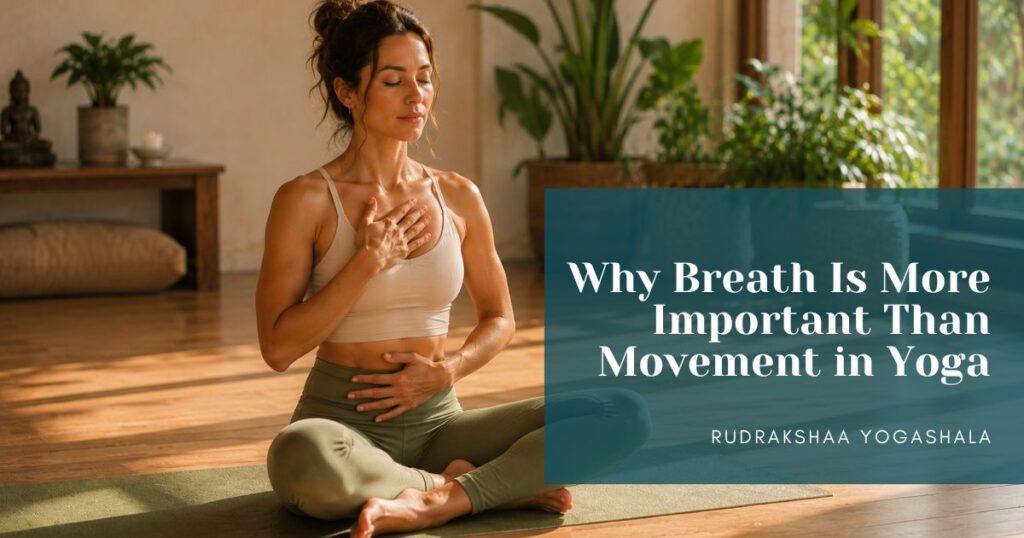
Chest-dominant breathing uses roughly the top third of lung capacity. Diaphragmatic breathing, where the belly rises on the inhale and falls on the exhale, uses significantly more volume and produces a much stronger calming effect.
Let the breath start the movement
The breath should initiate each action, not chase it. In a forward fold, the exhale begins before the body begins to descend. This keeps the nervous system connected to the movement rather than responding to it after the fact.
How Breath Changes the Quality of Practice
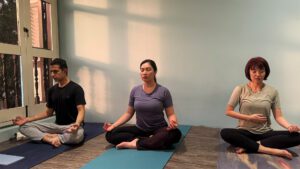
Students who shift their attention from poses to breath during yoga classes in Singapore tend to describe the same thing. A class that used to feel like a workout starts to feel like something released. Poses they struggled with physically became more accessible, not because their flexibility improved overnight, but because they stopped bracing against the movement.
Teachers read breath as diagnostic information. A student’s breath becoming laboured, irregular, or disappearing entirely in a pose tells a teacher more about what’s happening than their alignment does. Returning to smooth, audible breathing is the correction. Everything else tends to follow from it.
The connection between breath and mental clarity is equally significant. Yoga’s impact on cognitive function is, in large part, a breath story – the nervous system regulation that pranayama produces is the same mechanism that improves focus, reduces mental noise, and supports emotional steadiness off the mat.
Conclusion
The breath does not accompany the practice. It is the practice. If you have been attending yoga classes in Singapore and focusing mainly on getting the shapes right, try spending one class with your attention almost entirely on your breath. Not on whether it is perfect, just on whether it is moving. That shift alone, without changing anything else, tends to produce more noticeable improvement than months of working on flexibility.
At Rudrakshaa Yogashala, breath and pranayama sit at the centre of how classes are structured, which is what you’d expect from a studio rooted in traditional Hatha practice. Classes like Pranic Flow are specifically built around this breath-first approach. If this is something you want to go deeper into, rather than just encounter occasionally in a flow class, browse the full schedule, explore our range of sessions, or get in touch to find the right starting point.
Frequently Asked Questions
I forget to breathe during hard poses. How do I stop doing that?
Nearly every beginner does this. The fix is usually pace – if you are moving fast enough that breath awareness drops out, the sequence is running faster than your nervous system can track. Slow down deliberately. Held poses or modified versions give you more time to find the breath before moving on. Most teachers will not only allow this but actively encourage it once they know you’re working on it.
Is pranayama safe for people with anxiety?
Slow breathing and extended exhalation practices are generally very well-suited to anxiety. The ones to be careful with are the activating techniques – Kapalabhati, especially, which uses rapid forceful exhalations and can temporarily increase nervous system arousal. If you have anxiety or panic disorder, that is not a starting point. Begin with slow nasal breathing and work with a teacher who understands your situation before moving on to more advanced techniques.
Do I need a separate meditation class in Singapore to learn pranayama?
Not necessarily. Many yoga studios weave pranayama into regular classes, especially in Hatha and Yin formats. If you want more structured instruction in breathwork specifically, dedicated meditation classes in Singapore that focus on pranayama will go further than what gets covered in a general class. It depends on how seriously you want to pursue it.
How long before breath-focused practice makes a noticeable difference?
Most students feel something within the first few classes, where they genuinely pay attention to their breath rather than treating it as background. The parasympathetic response is not subtle when it kicks in. People who have been practising for months sometimes describe the shift as feeling like they finally understood what the class was actually for.
Can yoga breathing help with sleep?
Consistently, yes. Extended exhalations and slow nasal breathing practised before bed have been shown to reduce cortisol and support melatonin production. Even 10 minutes of slow breathing with a longer exhale than inhale, done lying down before sleep, is one of the better-evidenced non-pharmaceutical tools for sleep quality. It does not require a formal practice – just consistency.